Shared Governance Through Sociocracy
October 30, 2026
Last weekend I attended a workshop hosted by the Canadian Unitarian Council's UU Ecosystem Project called "Shared Leadership through Sociocracy". To be honest, I didn't really know what I was going to learn, but sociocracy sounded vaguely familiar, and the workshop description promised I would learn about collaborative government models that support distributed leadership and better, more resilient decision-making.
To be perhaps too honest, I expected it would probably be fairly dry and boring, but still, maybe have some useful info on organizational structure in Canadian UU churches, nonprofits and beyond. To my delight, I ended up totally enraptured.
Sociocracy was introduced as a governance system, a member of a category also containing for instance "democracy" and "Robert's Rules of Order", a system often used in business meetings and legislative bodies.
Robert's Rules of I Want to Win 🔗
One presenter started by pointing out some flaws in traditional ways of running governance meetings, focusing especially on Robert's Rules of Order. Robert's Rules are a formal specification with lots of arcane specifics, but that you would probably recognize in general: proposals are made by someone saying "I move that..." and someone "second"ing them, amendments to the initial proposal can be suggested as new motions, and eventually, there's a yes/no vote on all the proposals that require group agreement, like each of the major proposals or amendments. In high school, I even competed in a few parliamentary procedure competitions in FFA to show off by-the-book motion-making. "I rise to a point of order!"
So what's wrong with Robert's Rules? Well...
- it was designed for use in large bodies full of lots of individuals and groups in frequent confrontation with one another. Hopefully that is not your church or nonprofit board!
- binary win/lose format for each decision
- can be used to endlessly obstruct by those who know the rules well
- no obligation to win over a dissenting minority or convince anyone beyond meeting the "win" threshold for the vote
- fundamentally, it's a meeting organizing tool, not an organizational design
- in formal versions, all speech is addressed to the chair of the meeting, not to the other members.
Sociocracy: Decisions by Consent of the socio 🔗
Sociocracy is an alternative structure that leads to a more collaborative process. It encourages listening with the intent to find common ground. Each person should arrive with the intent, and even expectation, that their minds will be changed at some point in the meeting.
As Ben, one of the presenters on the panel put it:
"Sociocracy is the governing system that UUs have been looking for, and didn't know was out there."
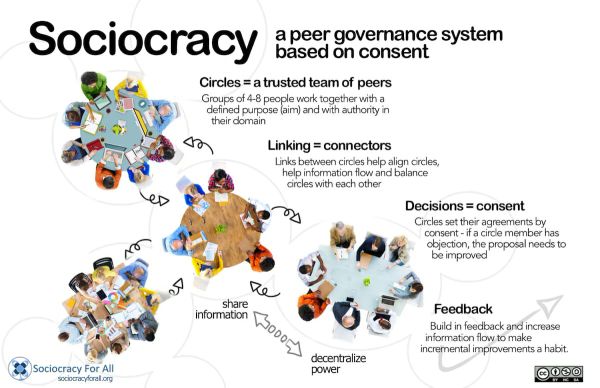
Sociocracy is based on the idea that the decision-making authority rests in the "socio": people in relationship with one another, who share goals. It is more similar to a consensus-based process than a majority-rules process, though it has some differences from other consensus-based processes. To make the differences more apparent, sociocracy calls itself a consent-based process rather than consensus. The decision heuristic for whether to adopt a decision is whether it is "good enough for now, safe enough to try".
But instead of asking everyone, "Do you agree?", we ask, “Do you object?” If no one objects, there is consent.
(Sociocracy for All)
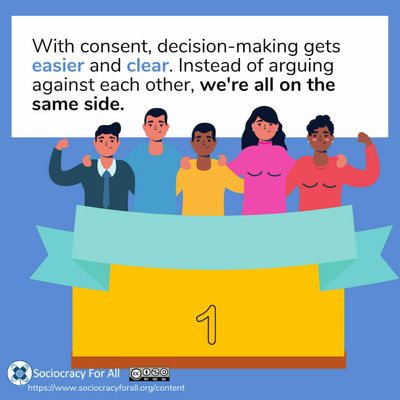
Objections in sociocracy are a good thing: they're a chance to refine a proposal and address concerns in order to get everyone on board. One panelist said he'd once shared with a sociocracy trainer that his circle seemed to be working well, and rarely dealt with objections. The trainer was politely horrified: objections should be coming up all the time! An objection does not mean conflict. They are a normal part of the process, and help the group make better decisions.
One panelist said consensus decision-making can be a challenge at first because it's so unfamiliar. We need to get comfortable finding the right decision for the group, not just getting what we each individually want.
Rounds and Circles, Circles and Rounds 🔗
Two key concepts of sociocracy that were highlighted in the workshop were circles and rounds.
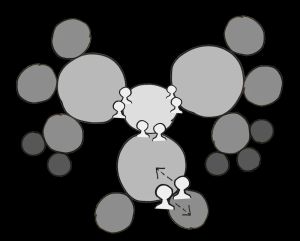
Sociocracy-based organizations are made up of overlapping circles that share a particular aim, and are composed of the people who are directly responsible for carrying out the work of their specific domain. For coordination and sharing across the organization, someone from each circle will also be in other circles and vice versa.
The round is a structure within meetings in which every member of the circle gets a chance to speak in defined order, before anyone speaks a second time. New rounds continue until there are no more objections to consider or comments being offered, and the group is ready for for a consent round, where each person individually gets a chance to say they either have no objection to the proposal as currently defined, or raise a new objection that must be considered by the group.
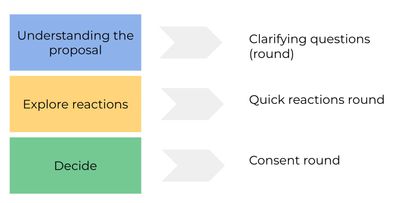
Panelists said the round format seems really like where the magic in sociocracy comes from. One speaker had started trying to implement sociocracy by using circles but not rounds, and floundered til they introduced rounds. Takeaway: if you want to dip your toes in, try rounds as your first change to your meeting structures!
The round structure makes people feel less anxious in meetings, because each person knows they will get a chance to speak, and that their concerns will by necessity be heard and addressed. The structure also encourages people to come to meetings prepared, having "done the reading" and ready to contribute as a full participant in the discussion.
One panelist gave a familiar example from traditional meetings: a proposal is being discussed, and two people are really excited about the topic, so they start going back and forth between themselves discussing it. Others don't get a chance to weigh in, and the discussion between the two eager beavers ends up carrying the conversation into minutiae, far from what's really at stake in the discussion of the original proposal. But woops, now we're out of time, time to vote! The round format makes this meeting anti-pattern less likely, not by frequent verbal reminders to give other people a chance to talk, but by shifting the format to guarantee equal participation by everyone who wants to speak. The guardrail is concrete and structural rather than theoretical.
Another panelist gave an example of how during a round, sometimes it starts seeming like everyone is basically on the same page, and you might think if we stop there, everyone would agree. Then the turn in the round comes for a quiet voice who says something that hasn't been considered at all yet, and you can see everyone light up with, "oh, that is so right, and I hadn't realized." It might entirely change what the eventual decision will be. Those moments seem to happen much more in sociocracy, according to the panelists, who all felt this was making their organizations make much better decisions overall.
Someone said that other board members have commented after a meeting, "wow, I have more energy now than I did coming in!" That is a rare and beautiful thing for any kind of meeting, in my experience!
Ideally, sociocracy processes start not with a yes/no decision to make, but a topic to explore more broadly: what matters to each of us about this topic? The facilitator, whose job is to "hold the container for the conversation", watches for what emerges as a common thread in comments by multiple members of the circle, and suggests a possible proposal that seems to reflect the will of the group. Then, that proposal can be discussed in rounds and refined to find what the group truly agrees on. Discussion continues until there are no substantial objections: concerns that the proposal, if adopted in its current form, would prevent the circle from advancing towards its aims
Some panelists mentioned that the person who creates the agenda is not the same person as the facilitator for the individual meeting. Many groups rotate the facilitation role even if the agenda-creator role stays constant. People generally appreciate this separation in roles and responsibilities.
Sociocracy in Big Groups 🔗
Someone asked, okay, but what about for a larger setting, like our annual congregation-wide meeting? In larger group settings, trust is built among the circles so that by the time a decision reaches the larger group, all the contentious parts of it have already been worked out in small groups that have been sharing information effectively about what was agreed upon or what issues were raised and addressed. There will always be individual, fiduciary decision-makers as required by the nonprofit legal structure here in Canada, but in a well-functioning sociocratic organization, these sign-offs can be more of a rubber stamp. If a large group vote of some kind is happening, and it's contentious, then the consent-building process has failed, and the group needs to return the discussion to rounds in smaller circles until group consent is achieved.
Note that not all of the panelists had fully implemented sociocracy in a larger structure like a whole congregation; some only used the structure among leadership or staff. Some hoped to eventually have the whole organization applying sociocracy, and some were somewhere in the middle of a transition process.
What about conflict? 🔗
In a traditional decision-making organizational structure, when there's a conflict that seems unresolvable, it gets escalated to authorities higher up in the hierarchy, like the board, committee chair, or a leader to hash it out and make a call. In sociocracy, it's the opposite: return a contentious decision to the circles until there is agreement that surfaces among the people who are responsible for the aims and the issue in question.
Sociocracy For All! 🔗
Panelists recommend the Sociocracy for All organization to learn more, and are excited that excitement about sociocracy seems to be building among Canadian UUs. People who are using it understand transitioning to sociocracy as a long-term process. It's a new structure to learn, but to make it work requires a transformative shift in mindset as well: from "us & them" to "me & we".
I'm really excited about the possibilities that could be unlocked by that transformation!